
We tend to think of anti-ageing as something we apply to the outside of the skin — a serum, a cream, a treatment. But some of the most powerful influences on how your face ages arrive on a plate. What you eat over years quietly shapes the collagen that keeps skin firm, the inflammation simmering beneath the surface, and the raw materials your body has to repair itself. The encouraging part is that, unlike your genes or the passage of time, diet is something you can actually control. Here is what the evidence says — and what it means in a typically British diet.
The sugar problem: glycation and your collagen
If there is one dietary villain in the story of skin ageing, it is excess sugar. When there is too much sugar circulating in the blood, those molecules bond onto structural proteins — including collagen — in a process called glycation. This creates compounds known as advanced glycation end-products, or AGEs (an unfortunately fitting acronym).
The problem is what AGEs do to collagen. They form cross-links that make the fibres stiffer, less pliable and more prone to fragmenting. Healthy collagen is springy and resilient; glycated collagen is brittle and breaks down more easily. The direct result is a measurable loss of skin firmness and elasticity — precisely the qualities that keep a face looking fresh.
It gets a little worse. AGE-modified collagen also signals skin cells called fibroblasts to self-destruct and prompts the release of enzymes that break collagen down further. So glycation delivers a double blow: it damages the collagen you have and suppresses the making of new collagen. AGEs do build up naturally as we age, but the process is significantly accelerated by dietary sugar, high-fat processed food, smoking and alcohol — which is exactly why diet is such a meaningful lever.
Glycation is one of the few drivers of skin ageing you can genuinely influence from the kitchen — every reduction in excess sugar is a reduction in ongoing collagen damage.
How much sugar is too much? The UK picture
Here the numbers are sobering. NHS guidance is that adults should have no more than 30g of free sugars a day — roughly seven sugar cubes. Yet historic UK survey data has found the average adult consuming close to three times that recommended amount.
More recent research paints the same picture from another angle: the average UK free-sugar intake sits at 12.4% of total energy, comfortably above the recommended 10% ceiling, and 61.3% of the British population exceeds that limit. Much of this is hidden in everyday foods rather than the obvious sweets and puddings.
A large part of the reason is ultra-processed food (UPF) — the packaged, industrially formulated products that make up a startling share of the modern British diet. UPFs account for an estimated 56.8% of total energy intake and 64.7% of total free-sugar intake in the UK, among the highest rates in Europe. Among children and adolescents the figures are higher still, at roughly 63.5% and 68% of energy — which matters because glycation damage accumulates across a lifetime. Encouragingly, modelling suggests that removing UPFs from the UK diet could cut the prevalence of excessive free-sugar intake by around 47%.
Beyond the sugar itself, UPFs are strongly linked to low-grade, chronic inflammation — sometimes called “inflammaging” — and supply the refined sugars and industrial fats that feed AGE formation. In other words, they hit the skin from several directions at once.
The nutrients that help skin age well
If sugar and processed food accelerate ageing, a genuinely varied, whole-food diet does the opposite by supplying the building blocks and protectors your skin depends on. A handful of nutrients stand out.
| Nutrient | What it does for skin | Good food sources |
|---|---|---|
| Vitamin C | Essential cofactor for making collagen; also a potent antioxidant | Citrus, peppers, broccoli, berries |
| Vitamin E | Protects cell membranes from oxidative damage; works with vitamin C | Nuts, seeds, vegetable oils, avocado |
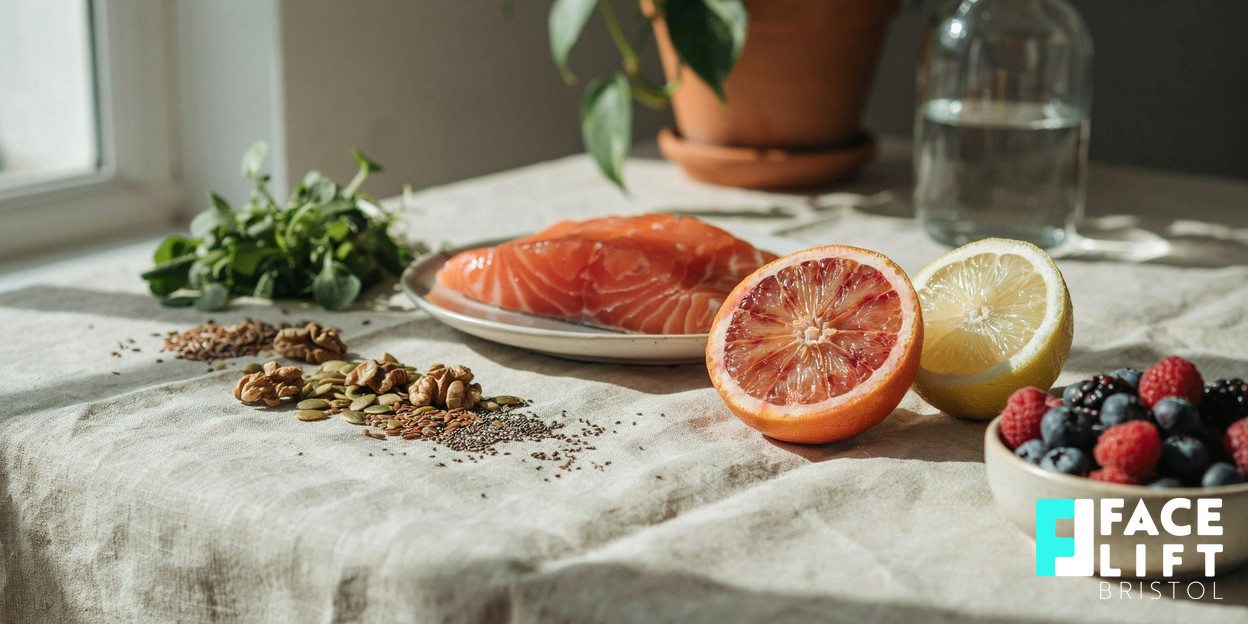
| Omega-3 fats | Calm inflammation and support the skin barrier | Oily fish (salmon, mackerel), flaxseed, walnuts |
| Zinc | Supports wound healing and collagen-making pathways | Meat, shellfish, legumes, seeds |
| Polyphenols | Antioxidant and anti-inflammatory; may even slow AGE formation | Green tea, berries, dark chocolate, colourful veg |
Vitamin C deserves a special mention because your body simply cannot build collagen without it — it is a required cofactor in the process. Pairing vitamin-C-rich produce with protein gives your skin both the instructions and the materials it needs.
Collagen precursors: can you eat your way to more collagen?
Your body makes collagen from amino acids — particularly glycine, proline and hydroxyproline — combined with vitamin C. That means protein-rich foods (meat, fish, eggs, dairy, legumes) alongside plenty of vitamin C give your skin a reliable supply of raw materials.
Collagen and gelatine sources such as bone broth, and popular collagen-peptide supplements, are often marketed as a shortcut. It is a reasonable idea, but an honest summary is that whether ingested collagen is meaningfully rebuilt into your skin’s own dermal collagen remains an area of ongoing research rather than settled clinical fact. You lose nothing by including these foods, but a balanced, protein-and-vitamin-C-rich diet is the dependable foundation — with or without a supplement.

Hydration: helpful, but not magic
Few beauty claims are repeated as often as “drink more water for younger skin”. Adequate hydration genuinely supports the skin’s outer barrier and helps it function well. But the clinical evidence that simply drinking more water — beyond correcting real dehydration — delivers a dose-dependent cosmetic benefit is thinner than popular articles suggest. Think of hydration as a necessary baseline rather than a stand-alone anti-ageing treatment, and one that works best alongside good topical skincare and cutting back on dehydrating inputs like alcohol and excess caffeine.
Foods that speed ageing up
Alongside eating more of the good, it helps to ease off the accelerators:
- High-glycaemic foods — white bread, sugary drinks and sweets cause rapid blood-glucose spikes that drive glycation and AGE formation.
- Trans fats — promote inflammation and oxidative stress.
- Alcohol — dehydrating and pro-inflammatory, it also encourages AGE formation and depletes skin-supporting nutrients (we cover this in our guide to alcohol and facial ageing).
- Excess salt — contributes to fluid retention and facial puffiness, and is linked with broader effects on vascular ageing.
That last point is a useful practical one: cutting back on salt and alcohol in the days before a big event can visibly reduce facial puffiness and redness.
Diet as one pillar — not the whole house
It is worth being clear-eyed about what diet can and cannot do. Eating well protects the collagen you already have and supplies the materials to make more, which is powerful prevention. What it cannot do is lift or re-tighten skin that has already lost its structure, or reverse deep-set laxity. Diet is a slow, cumulative influence — a foundation, not a facelift.
This is exactly why nutrition and in-clinic treatment work so well together rather than as rivals. Reducing free sugar and ultra-processed food limits ongoing glycation, helping to protect the very collagen that collagen-stimulating treatments are working to rebuild. A diet rich in vitamin C, omega-3s, zinc and polyphenols supplies the biological raw materials your skin draws on to respond to treatment. In practice, someone eating well tends to get more from — and hold onto more of — the results of collagen-building approaches such as radiofrequency skin tightening, HIFU and biostimulatory injectables.
Diet also sits within the bigger picture of lifestyle and skin. It works hand in hand with protecting your skin from the sun (see UV, sun damage and photoageing), managing sleep, stress and cortisol, and understanding which parts of ageing you can influence at all — the theme of our guide to intrinsic versus extrinsic ageing.
Where to start
You do not need a dramatic overhaul. Nudging free sugar and ultra-processed food back toward NHS guidelines, adding a portion of oily fish and a couple more colourful vegetables, and keeping alcohol and salt modest will, over time, help your skin age on its own terms.
If you would like to combine those everyday habits with a treatment plan tailored to your skin, we would love to help. Book a consultation with our team for an honest assessment of your skin, your goals and the approaches — from lifestyle to collagen-stimulating treatments — most likely to genuinely suit you.
Pros & Cons
Pros
- Diet is a genuinely controllable lever in an otherwise progressive ageing process
- Cutting free sugar and ultra-processed food helps limit ongoing collagen damage
- Nutrient-rich eating supports the raw materials your skin needs to repair itself
Cons
- Diet works slowly and preventatively — it cannot reverse established laxity or deep lines
- No single food or supplement is a proven anti-ageing cure; balance matters more than trends
Frequently Asked Questions
Does sugar really age your skin?
Excess sugar drives a process called glycation, where sugar molecules bond to collagen and make its fibres stiffer, more brittle and prone to breaking down. Over years this reduces firmness and elasticity, so consistently high sugar intake can contribute to how quickly skin ages.
Which foods are best for skin ageing?
A varied diet rich in vitamin C (citrus, peppers, berries), vitamin E (nuts, seeds, avocado), omega-3 fats (oily fish, walnuts), zinc (shellfish, legumes, seeds) and polyphenols (green tea, colourful vegetables) supports collagen production and helps protect skin from oxidative damage.
Do collagen supplements work?
The idea is appealing, but whether swallowed collagen peptides are meaningfully rebuilt into your skin's own collagen is still an area of active research rather than settled science. A protein-rich, vitamin-C-rich diet reliably gives your body the building blocks to make collagen itself.
Will drinking more water make my skin look younger?
Staying properly hydrated is a sensible baseline for healthy skin, but for most people already drinking normal amounts, extra water alone is not a proven anti-ageing treatment. It is best seen as one supporting habit alongside sun protection, good nutrition and skincare.
Can diet replace anti-ageing treatments?
No. Diet is best understood as a complementary pillar that protects the collagen you have and supports your skin's raw materials. It cannot lift or tighten skin the way collagen-stimulating treatments can, but it helps you get and keep more from them.